Arithmetic Operation in Python
The most basi arithmetic operations that can be done in Python are : Addition, Substration, Multipication and Division.
And these operations are performed using the following operations.
+ => Addition
- => Substration
* => Multipication
/ => Division
You can use follwing operators to perform higher level arithmetic operations.
In the next lecture, we will examine what these operators do one by one.
% => Mod
// => Floor Division
** => Exponetiate
Mod is the remainder obatined by dividing a number by another number. It is performed using the % operator in Python.
For example, the remainder of dividing 29 by 7 is 1.

Another used operator in Python is the floor division operator. This gives us the full demical part of the result after a division.
In python, you can do this using the double slash // character.

Last operator to review is the double asterik. You can apply exponetiation with this operator.

We can perform arithemetic operations on a variable and equate it to itself.
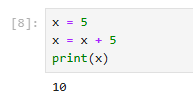
We can also do the same operation like this:
We can put the operator of the arithmetic operation we want beofre the eqauls operator and create the new variable in a shorter time.

Note : you can do this with the operators used in all other arithmetic operations.
Arithmetic operations have an order of procedence. This order is as follows :
Parentheses > Exponents > Negative Numbers > Multipication and Division > Addition and Subtraction